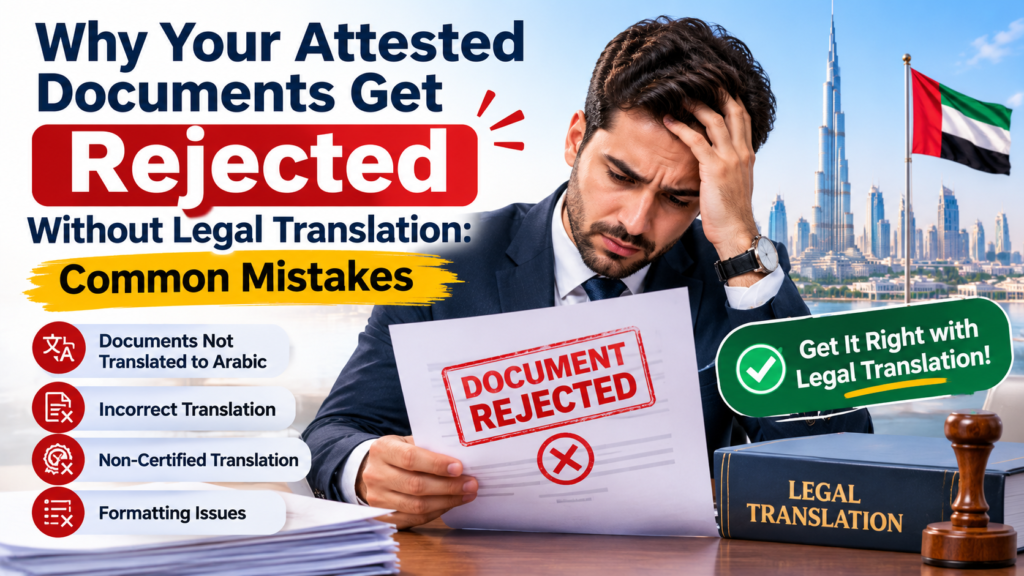
Designed with a Dubai legal-services theme, highlighting document rejection, common translation mistakes, and the importance of certified Arabic legal translation.
Uncategorized

Why Your Attested Documents Get Rejected Without Legal Translation: Common Mistakes

Getting your documents attested is an important step when preparing paperwork for official use in the UAE. However, attestation alone does not always mean your documents are ready for submission. Depending on the document and the receiving authority, you may also need a legal translation. Many people face delays because of incorrect translations, missing stamps, or incomplete documents. Understanding these common mistakes can help you avoid unnecessary expenses and make the submission process easier. Why Is Legal Translation Important After Attestation? Attestation verifies the authenticity of a document or the relevant signatures and seals through the applicable authorities. Legal translation converts the document’s content into the required language while preserving its original meaning. For example, educational certificates, marriage certificates, and powers of attorney may require Arabic legal translation when submitted to certain UAE authorities. However, not every attested document requires legal translation. The requirements depend on the document type, its purpose, and the authority receiving it. 1. Using Google Translate for Legal Documents One common mistake is using free online translation tools for official documents. While Google Translate can help users understand general content, it may not accurately handle specific legal terms and formal expressions. A small error in a marriage certificate, business agreement, or power of attorney can change the intended meaning. Online tools also do not provide official certification or a legal translation stamp. How to avoid it: If your document requires an official translation, choose a qualified legal translation provider that meets the receiving authority’s requirements. 2. Missing the Required Stamp or Certification Even when the original document is attested, its translation may need separate certification. Some authorities require translations from a Ministry of Justice (MOJ)-approved translator or another authorised provider. Submitting a translation without the required stamp or certification details may result in the document being returned. How to avoid it: Confirm the receiving authority’s requirements before translating your documents. Check that the translated version includes all required stamps and certification details. 3. Incorrect Legal Terms or Personal Details Legal translation involves more than replacing words from one language with another. The meaning and legal context of the original document must remain accurate. Errors in names, dates, passport numbers, certificate numbers, or legal terminology can create confusion and delay official procedures. How to avoid it: Choose a legal translation service familiar with UAE documentation. Before submission, compare the translation with the original and verify all important details. 4. Missing Signatures or Incomplete Documents Sometimes, document rejection happens because the original paperwork or translated version is incomplete. Missing signatures, official seals, supporting pages, or other required information can affect acceptance. For example, submitting only part of a multi-page agreement may cause problems during verification. How to avoid it: Make sure that all pages and required supporting documents are included. Check whether signatures, seals, and other details are necessary before submitting your paperwork. 5. Ignoring the Receiving Authority’s Requirements Different authorities may follow different document submission rules. Requirements for visa applications, court proceedings, and business registration may not be the same. Assuming that every document follows the same process can lead to unnecessary delays. How to avoid it: Confirm whether your document requires legal translation, attestation, notarisation, or additional certification. Checking these requirements in advance can save time and effort. Checklist to Avoid Document Rejection in the UAE Before submitting your documents, make sure you: Choose the Right Legal Translation Service in Dubai Preparing documents for official use in the UAE can feel complicated, particularly when attestation and legal translation are both involved. Understanding the requirements and checking your paperwork carefully can help prevent common mistakes. LAFZ Translation Services helps individuals and businesses understand their legal translation requirements for personal documents, business agreements, and other official paperwork. If you need legal translation in Dubai, contact LAFZ Translation Services to discuss your document requirements and identify the appropriate next steps. Frequently Asked Questions 1. Can attested documents be rejected without legal translation? Yes. If the receiving authority requires a legal translation and it has not been provided, the document may be returned. 2. Is Google Translate accepted for legal documents in the UAE? Online tools do not provide officially certified legal translations. If certification is required, use a provider that meets the authority’s requirements. 3. Does every attested document need an MOJ-approved translation? No. Requirements depend on the document and the authority receiving it. 4. What should I check before submitting translated documents? Verify names, dates, numbers, legal terms, required stamps, certification details, and document completeness.

Why Your Attested Documents Get Rejected Without Legal Translation: Common Mistakes Read Post »
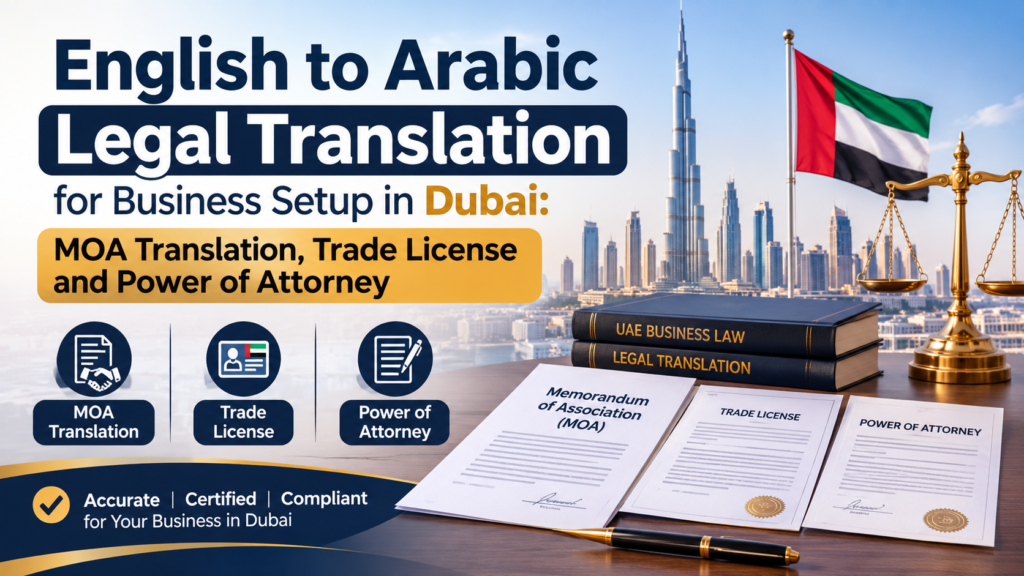
professional Dubai business and legal-services theme in a wide landscape format.
Uncategorized

English to Arabic Legal Translation for Business Setup in Dubai: MOA Translation, Trade License and Power of Attorney

Starting a business in Dubai offers many opportunities for entrepreneurs and investors. However, setting up a company also involves preparing several legal documents and meeting the requirements of the relevant authorities. If your documents are in English or another language, you may need an Arabic translation before submitting them for official purposes. From company formation documents to trade licences and powers of attorney, accurate translation helps authorities understand your business information and legal arrangements. This is where business setup translation Dubai services can help Choosing the right one can help you prepare your documents correctly and reduce the risk of delays caused by translation or documentation issues.. Key Business Documents That May Need Legal Translation 1. Memorandum of Association (MOA) and Articles of Association (AOA) The Memorandum of Association (MOA) is an important company document that sets out key details about the business. Depending on the company structure, it may include information about shareholders, share capital, ownership percentages, and the company’s activities. The Articles of Association (AOA), where applicable, describe rules for managing the company and how certain decisions are made. When these documents need to be submitted in Arabic, accurate translation is essential. A mistake in a shareholder’s name, ownership percentage, or legal clause could create confusion or require corrections. For example, if two partners are establishing a company in Dubai, their MOA may describe each partner’s ownership share and responsibilities. The Arabic version must reflect the original information correctly. Some company formation procedures require bilingual documents, while others follow specific formats set by the relevant authority. Before arranging the translation, confirm the required format and whether the document needs further authentication or execution before a notary. 2. Power of Attorney (POA) A Power of Attorney is a legal document that allows one person to authorise another person to act on their behalf within the powers stated in the document. Business owners may use a POA when they cannot attend certain procedures themselves. For example, an overseas investor may authorise a representative to handle specific company formation formalities in Dubai. Because a POA defines what a representative is allowed to do, its wording must be clear and accurate. The translation should preserve the scope of authority, names, identification details, and any conditions mentioned in the original document. If the POA was issued outside the UAE, it may need authentication or attestation before it can be used locally. The required steps depend on the country of origin and the purpose of the document. A POA prepared in the UAE may also need to follow specific notarial procedures. Check the requirements before translating or submitting the document to ensure that it meets the relevant authority’s rules. 3. Trade Licences and Company Registration Documents A trade licence identifies a business and the activities it is authorised to carry out. When an overseas company plans to open a branch or subsidiary in Dubai, it may need to provide documents proving that the parent company is legally established. Depending on the registration process, these documents may include a certificate of incorporation, an existing trade licence, a certificate of good standing, or other company records. If the documents are in English or another language, the relevant authority may require an Arabic legal translation. Accurate translation helps ensure that the company’s registered name, business activities, registration details, and other information are presented correctly. Requirements can differ between mainland registration and free zone company formation. It is therefore important to confirm the specific document list and translation rules with the relevant authority before proceeding. 4. Board Resolutions and Shareholder Documents Companies may need board resolutions or shareholder resolutions when establishing a business, appointing a manager, authorising a representative, or approving certain business decisions. These documents record decisions made by the company’s board or shareholders. They may include the names of authorised persons, the scope of their responsibilities, and details of the decisions being approved. If a resolution must be submitted to a UAE authority, translated documents may be required depending on the procedure. The translation must accurately reflect the decision and the authority granted to the relevant person. This is especially important when an overseas company is opening a branch in Dubai  How Does the Translation and Attestation Process Work? If you are using documents issued outside the UAE, you may need to complete several steps before submitting them. The correct order depends on the document and the country where it was issued. Step 1: Check the Requirements Identify the documents needed for your company registration and confirm whether they require Arabic translation, attestation, or other authentication. Step 2: Complete the Required Procedures in the Country of Origin Some foreign documents must be verified by the issuing authority or other designated authorities in the country where they were issued. Step 3: Arrange UAE Embassy or Consular Authentication, Where Required Depending on the applicable process, the documents may need authentication by the UAE Embassy or Consulate in the country of origin. Step 4: Complete UAE MOFA Attestation, Where Required The UAE Ministry of Foreign Affairs (MOFA) provides attestation services for eligible documents. Check whether this step applies to your particular document. Step 5: Arrange Legal Translation If Arabic legal translation is required, use a translator licensed by the UAE Ministry of Justice where applicable. Confirm whether the original document, stamps, and authentication details must be included in the translation. How LAFZ Translation Services Can Help Preparing company documents for registration can be challenging, especially when you are establishing a business from another country. Understanding the translation and authentication requirements early can help you organise your paperwork more efficiently. Our business setup translation Dubai services can support your document preparation needs by helping you identify the appropriate translation requirements for your company formation process. Whether you need an MOA translated, a Power of Attorney prepared for translation, or company registration documents translated into Arabic, our team can help you understand the appropriate next steps. Before proceeding, share the type of document you have, the country where it was

English to Arabic Legal Translation for Business Setup in Dubai: MOA Translation, Trade License and Power of Attorney Read Post »

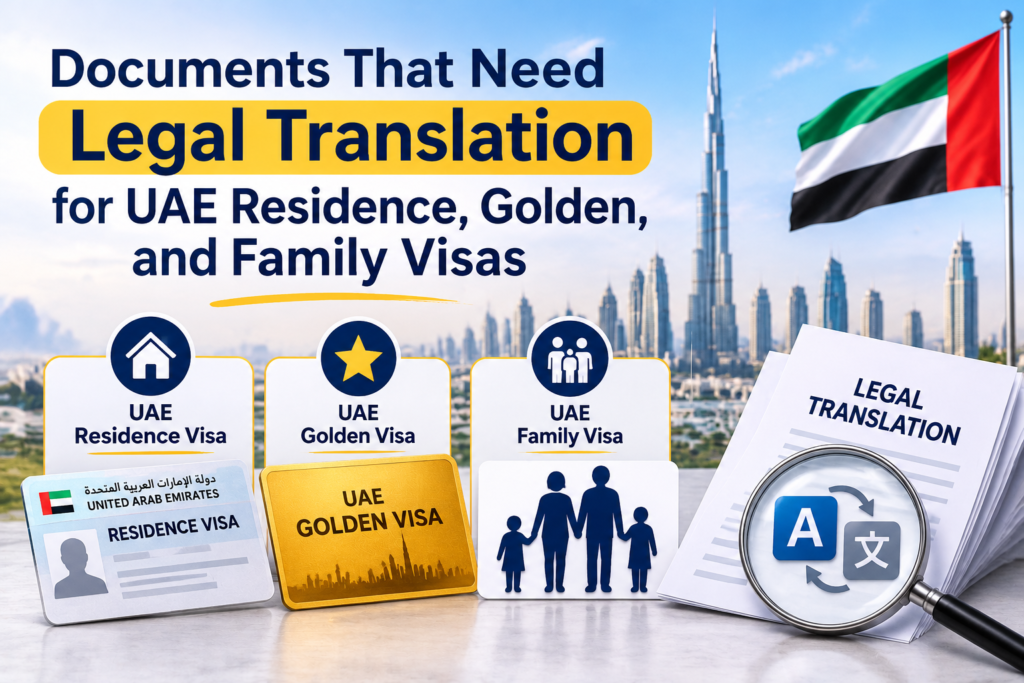
Designed with UAE Residence Visa, Golden Visa, and Family Visa themes, highlighting the importance of legal document translation.
Uncategorized

Documents That Need Legal Translation for UAE Residence, Golden, and Family Visas

Applying for a UAE visa involves several documents, and knowing which ones need translation can save you time and effort. Whether you are moving to the UAE for work, applying for a Golden Visa, or bringing your family to live with you, it is important to prepare your documents according to the requirements of the relevant authorities. If your documents were issued in another country, you may need to get them attested, translated, or both before submitting your application. The requirements depend on the type of visa, the document, its language, and the authority handling your application. 1. Documents Required for a UAE Family Visa If you want to sponsor your spouse, children, or other eligible family members, you will need documents that establish your relationship and meet the relevant sponsorship requirements. The documents required may vary depending on whom you are sponsoring and your individual circumstances. Marriage Certificate: If you are sponsoring your spouse, you may need to provide your marriage certificate as proof of your relationship. If the certificate was issued outside the UAE, it may require attestation and Arabic legal translation, depending on the requirements of the relevant authority. Birth Certificate: Parents sponsoring their children may need to submit birth certificates to establish parentage. Translation and attestation may be required for certificates issued abroad. Salary Certificate or Employment Contract: These documents may be requested to confirm your employment and income when applying to sponsor family members. If translation is required, the language and certification requirements should be confirmed with the relevant authority. Passport Copies and Other Supporting Documents: You may also need passport copies, residency details, and other supporting documents for yourself and your family members. 2. Documents Required for a UAE Golden Visa The UAE Golden Visa provides long-term residency to eligible individuals in categories such as investors, entrepreneurs, specialised professionals, exceptional talents, and outstanding students. The eligibility criteria and supporting documents depend on the category under which you apply. Some documents may need translation or attestation if they were issued outside the UAE. Educational Certificates: Applicants in certain professional, academic, or specialised categories may need to submit degrees, diplomas, or other educational qualifications. Depending on the application, these documents may require attestation, translation, or additional verification. Professional Licences: Doctors, specialists, and other regulated professionals may need to provide licences or certificates proving their qualifications and professional status. The relevant licensing authority determines the required documents and format. Business and Company Documents: Entrepreneurs and investors may need to submit trade licences, company registration documents, shareholder records, or other papers to support their applications. Financial Documents: Depending on the category, applicants may be asked to provide bank statements, investment records, or financial reports. Translation may be necessary if the documents are not in an accepted language. Not every Golden Visa applicant needs all these documents. It is important to identify your eligibility category and follow its specific requirements before arranging translation or attestation. 3. Documents for Residence and Employment Visas People applying for standard residence or employment visas may also need to prepare documents issued outside the UAE. The exact requirements depend on the visa type, employer, profession, and relevant authority. Educational Certificates: Certain jobs require proof of educational qualifications. Your employer or the relevant authority may request an attested certificate and, where necessary, a legal translation. Police Clearance Certificate: A police clearance certificate may be requested for specific jobs, applications, or other official purposes. Whether translation or attestation is required depends on the application. Medical Records: UAE residence visa applications generally include a local medical fitness procedure. However, some professional or specialised applications may require additional medical reports. If these reports are issued in another language, the receiving organisation may request a translation. Bank Statements and Financial Records: Some visa categories, including certain self-sponsored or remote-work arrangements, may require proof of income or financial resources. If translation is needed, confirm which languages and document formats are accepted. The safest approach is to check your visa category’s requirements rather than assuming that every applicant must submit the same documents. Quick Checklist: Which Documents May Need Translation? Here is a simple overview of common documents and when translation may be required. Document Possible purpose What to check Marriage certificate Family visa Attestation and Arabic translation requirements Birth certificate Child sponsorship Proof of relationship, attestation, and translation Degree or diploma Employment or eligible Golden Visa categories Attestation, translation, and any required verification Police clearance certificate Specific employment or visa applications Whether the certificate is required and needs translation Bank statements Certain visa or investment categories Accepted language and document format Professional licence Regulated professions Translation and requirements of the relevant licensing authority Company documents Business or investor applications Authentication and translation requirements Medical reports Specific professional or medical evaluations Whether additional reports and translation are required This checklist is a general guide. Not every document needs legal translation, and some documents may require attestation or other verification instead. Always confirm the latest requirements for your application. 4. How Does the Translation and Attestation Process Work? If you have documents issued outside the UAE, you may need to complete several steps before submitting them. The correct order depends on the document and the country where it was issued. Step 1: Check the Requirements First, confirm which documents you need and whether they require translation, attestation, or both. This can help you avoid unnecessary work. Step 2: Complete the Required Verification in the Country of Origin Some documents must be verified by the issuing authority or other designated authorities in the country where they were issued. The process varies by country and document type. Step 3: Complete UAE Embassy or Consular Attestation, Where Required Depending on the applicable process, the document may need authentication by the UAE Embassy or Consulate in the country of origin. Step 4: Arrange UAE MOFA Attestation, Where Required The UAE Ministry of Foreign Affairs (MOFA) provides attestation services for eligible documents. Whether this step is necessary depends on the document and its intended use. Step

Documents That Need Legal Translation for UAE Residence, Golden, and Family Visas Read Post »

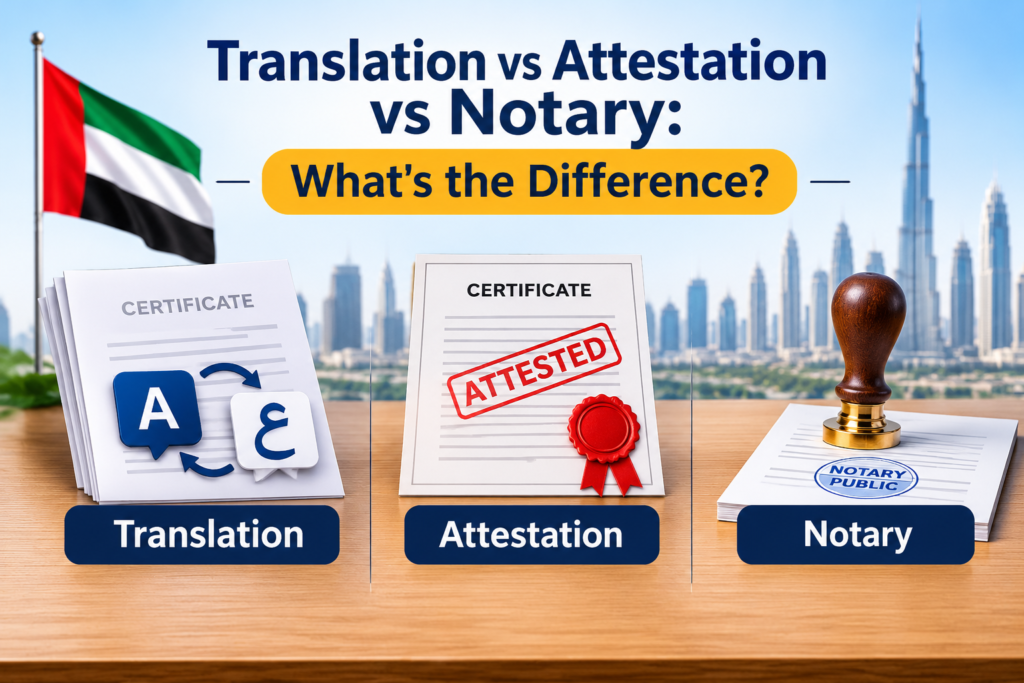
Professional UAE-themed blog banner comparing the three services: Translation, Attestation, and Notary, with Dubai skyline and UAE flag.
Uncategorized

Translation vs Attestation vs Notary: What’s the Difference?

When preparing documents for official use in the UAE, you may come across three terms: translation, attestation, and notary services. Although they are often mentioned together, each serves a different purpose. Understanding the difference can help you choose the right service and avoid unnecessary delays. For example, you may need to translate a marriage certificate, attest an educational qualification, or have a power of attorney legally prepared or authenticated. The process depends on the document and where you intend to use it. At LAFZ Translation Services, we help individuals and businesses understand their document requirements and access suitable translation, attestation, and notary-related services in the UAE. What Is Translation? Translation is the process of converting written content from one language into another while preserving its original meaning. It is useful when your document needs to be understood by a person, organisation, or authority that uses a different language. For example, if your marriage certificate is issued in a language that a UAE authority does not accept, you may need an Arabic translation. Similarly, a company entering into an agreement with an international partner may need its contracts translated so that both parties understand the terms. Common documents that may require translation include birth and marriage certificates, educational certificates, employment contracts, business agreements, court documents, powers of attorney, and company records. However, not every translation is suitable for every purpose. Some official procedures require a translation completed by an authorised legal translator. Before arranging a translation, check the requirements of the organisation that will receive the document. What Is Document Attestation? Document attestation is an official process used to verify a document through the relevant authorities. It helps establish that a document, signature, or official seal has been authenticated according to the applicable procedure. Attestation is often required when documents issued in one country need to be used in another. In the UAE, this may apply to educational certificates, marriage certificates, birth certificates, and certain commercial documents. For example, someone moving to the UAE for employment may need to submit an educational certificate to their employer or a government authority. Depending on the purpose and applicable rules, the certificate may need verification by authorities in the country where it was issued, followed by the required UAE authentication process. The exact steps depend on the document type and country of origin. Some documents may require several stages of verification, while others follow a different procedure. It is important to remember that attestation does not translate a document. It verifies the document through the relevant official process. If the document is in a language that the receiving authority does not accept, translation may also be necessary. What Are Notary Services? Notary services relate to the official preparation, witnessing, certification, or authentication of certain documents and signatures, depending on the applicable rules and the authority providing the service. These services may be required for documents such as powers of attorney, declarations, affidavits, agreements, and other legal paperwork. The exact requirement depends on the document and its intended use. For example, if you want to authorise another person to handle a particular matter on your behalf, you may need a power of attorney. Depending on the circumstances, the document may need to be prepared in the required format and completed through a competent notary or other authorised authority. Notary services are different from translation and attestation. A notary process does not automatically translate a document or complete every authentication step required for international use. It is also important to understand that translation offices and notaries have different roles. A translation provider can assist with preparing a translated document, while the required notarial act must be completed by the appropriate authorised person or authority. Translation vs Attestation vs Notary: Key Differences The easiest way to understand these three services is to look at what each one does. Translation helps people understand a document written in another language. It focuses on the meaning and accuracy of the content. Attestation verifies a document through the relevant official authorities. It is commonly required when certain documents need to be used for official purposes, particularly across countries. Notary services deal with specific legal formalities, such as witnessing signatures or authenticating documents, according to the authority’s powers and applicable rules. Although these services can be connected, they are not interchangeable. A translated document is not automatically attested, and an attested document is not automatically translated. Similarly, notary services do not replace every other verification requirement. What Is the Correct Order: Translate, Attest, or Notarise First? There is no single order that applies to every document. The correct process depends on the document type, where it was issued, and the requirements of the authority receiving it. In some cases, a document must first be authenticated in its country of origin before it can be translated or attested in the UAE. In other situations, translation may be needed at a particular stage of the process. A power of attorney may also require specific notarial formalities before further authentication. For example, an educational certificate issued overseas may need verification by the relevant authorities in its country of origin, followed by the required UAE attestation. If the certificate is not in an accepted language, a suitable translation may also be required. A power of attorney may follow a different process, depending on whether it is prepared in the UAE or overseas and how it will be used. The best first step is to confirm the requirements before starting. This helps you avoid repeating work, paying for unnecessary services, or submitting documents in the wrong format. Common Situations Where You May Need These Services If you are applying for a job in the UAE, you may need educational certificates verified and, depending on the requirements, translated. The process will depend on the employer, the relevant authority, and the purpose of the application. If you are sponsoring family members, your marriage or birth certificate may require attestation, translation, or both. Checking the requirements in advance can

Translation vs Attestation vs Notary: What’s the Difference? Read Post »

professional UAE legal theme with Dubai skyline, UAE flag, Arabic–English translation, and legal elements.
Uncategorized

Legal Translation in UAE: When Do You Actually Need It?

Living or working in the UAE often means dealing with important documents. You may need to apply for a visa, sign a business agreement, submit papers to a court, or provide certificates for an official process. If these documents are in a language that the receiving authority does not accept, you may need a translation. This is where legal translation becomes important. It helps ensure that a document’s original meaning is clearly understood in another language. Knowing when you need legal translation in Dubai can help you prepare the right documents, avoid unnecessary delays, and make official procedures easier. What Is Legal Translation? Legal translation is the process of translating documents related to legal matters, official procedures, and business agreements. It requires careful attention to words, names, dates, numbers, and legal terms because even a small mistake can change the meaning of a document. For example, an employment contract may include details about salary, working hours, responsibilities, and notice periods. These details must remain accurate when the contract is translated. In the UAE, certain courts, government departments, and other authorities may require documents to be translated by an authorised legal translator. The exact requirements depend on the type of document and where it will be submitted. 1. When Submitting Documents to a Court Court cases often involve documents that must be understood clearly by everyone involved. If your documents are written in a language that the court does not accept, you may need an Arabic translation that meets the court’s requirements. These documents may include court orders, legal notices, contracts, affidavits, witness statements, and supporting evidence. Individuals involved in family disputes, employment cases, or business disagreements may need legal translation as part of their proceedings. Accuracy is especially important in these situations. A poorly translated sentence could change how a statement or agreement is understood. Using a qualified legal translator helps preserve the original meaning and important details. Before submitting any translated document, check the requirements of the relevant court or seek guidance from your legal representative. 2. For Visa and Immigration Applications Visa and residency applications are common reasons people need document translation in the UAE. Residents may need to submit personal documents for family sponsorship, employment, education, or other immigration-related procedures. For example, a person applying to sponsor their spouse may need to provide a marriage certificate. Parents may also need their children’s birth certificates for certain applications. If these documents are issued in a language that the relevant authority does not accept, translation may be required. Depending on the situation, you may also need to attest your documents before submitting them. Attestation and translation are different processes: translation changes the language while preserving the meaning, whereas attestation verifies a document through the required official procedures. Checking the requirements before starting can help you understand which services you need. 3. For Employment Contracts and Labour Matters Employment contracts contain important information about the relationship between an employer and an employee. They may include salary details, job responsibilities, working conditions, benefits, and other terms. Legal translation may be required when these documents need to be submitted to an authority or reviewed by people who use different languages. For instance, an employee involved in a workplace dispute may need a translated employment contract or related correspondence. Businesses with employees from different countries may also need translated policies, agreements, and official communications. Accurate translation helps everyone understand their responsibilities and reduces the chance of confusion. 4. When Starting or Managing a Business Dubai attracts entrepreneurs, investors, and companies from around the world. Businesses often work with international partners, suppliers, and customers, which creates a need for accurate translation of commercial and legal documents. Common examples include business contracts, shareholder agreements, company resolutions, powers of attorney, and company formation documents. These papers may need translation when they are submitted to an authority or used for a formal business transaction. For example, a company working with an overseas partner may need an agreement translated so that both parties understand their responsibilities, payment terms, and conditions. Professional translation helps preserve the meaning of the original document and supports clear communication between the parties involved. The exact requirements depend on the purpose of the document and the authority or organisation receiving it. 5. For Personal and Family Documents Legal translation is not limited to courts and businesses. Individuals may also need translated documents for marriage, family matters, education, property transactions, or other official procedures. Documents such as birth certificates, marriage certificates, divorce records, inheritance documents, and powers of attorney may require translation depending on their intended use. For example, someone submitting a marriage certificate for an official application may need to provide a translated version. Similarly, a person handling a family or property matter may need documents translated before they can be reviewed by the relevant authority. Always check whether the receiving organisation requires a standard translation, an authorised legal translation, attestation, or a combination of these services. Legal Translation and Attestation: What Is the Difference? Legal translation and attestation serve different purposes. Understanding the difference can help you prepare your documents correctly. Legal translation converts a document from one language into another while preserving its original meaning. Attestation is an official process used to verify a document through the relevant authorities. For example, an educational certificate issued outside the UAE may need attestation before it can be used for a particular purpose. If the certificate is not in an accepted language, translation may also be necessary. Not every document requires both services. The requirements depend on the document’s origin, intended use, and the authority receiving it. It is always best to confirm these details before beginning the process. How to Prepare Your Documents for Translation Preparing your documents in advance can make the process easier. First, identify where the document will be submitted and confirm the language and certification requirements. Keep the original document available and provide a clear copy for an initial review. Check that names, dates, reference numbers, stamps, and other

Legal Translation in UAE: When Do You Actually Need It? Read Post »

legal translation services
Uncategorized

Legal Translation Simplified: Key Facts and Benefits

In today’s fast-growing global world, businesses are no longer limited to one city or one country. Companies now reach customers across different regions, cultures, and languages. While this growth brings many opportunities, it also brings one major challenge is language barriers. This is where professional translation services play a very important role.

Legal Translation Simplified: Key Facts and Benefits Read Post »

legal translation
Uncategorized

Understanding Legal Translation: Key Aspects and Challenges

In today’s fast-growing global world, businesses are no longer limited to one city or one country. Companies now reach customers across different regions, cultures, and languages. While this growth brings many opportunities, it also brings one major challenge is language barriers. This is where professional translation services play a very important role.

Understanding Legal Translation: Key Aspects and Challenges Read Post »

certificate attestation
Uncategorized

What Are the Common Issues Faced During the Attestation Process?

In today’s fast-growing global world, businesses are no longer limited to one city or one country. Companies now reach customers across different regions, cultures, and languages. While this growth brings many opportunities, it also brings one major challenge is language barriers. This is where professional translation services play a very important role.

What Are the Common Issues Faced During the Attestation Process? Read Post »

Uncategorized

The Importance of Professional Translation Services for Businesses

In today’s fast-growing global world, businesses are no longer limited to one city or one country. Companies now reach customers across different regions, cultures, and languages. While this growth brings many opportunities, it also brings one major challenge is language barriers. This is where professional translation services play a very important role.

The Importance of Professional Translation Services for Businesses Read Post »

Need an appointment

We’re here to help you with all your translation and legal needs at LAFZ.

Location

Lafz Translation Service,Al Shoala Building, Office 402, Port Saeed, Deira, Dubai – UAE

Inquiry

Contact for appointment
lafztranslation@gmail.com

© 2025 Lafz Translations

Scroll to Top